Saturday, January 7, 2012

if you don't use it, you lose it


      I was worried that if I stopped posting things I would get out of the habit and not continue when I got back in the southern hemisphere, so here are a few snaps of what has been going on around me over the past three weeks. 


What has two thumbs, speaks French, and loves the Winter Solstice HanChriKwanfest celebration extravaganza?
Moi.

First breakfast home from Peru. I better enjoy these cause they don't cook'em like this down there.


Sunset off the port bow. USS North Carolina. Cape Fear River.


The ultimate tour group.
From left to right: yours truly, Cousin John Tilney, Uncle Phil Payonk,  C. Douglas Jewell II (Dad),  Cousin Sarah Futrell, Cousin Ben Futrell, My Brother From Another Mother Chris Upright

Family Tradition. Oysters, steamed to perfection.
Uncle Phil Payonk, Sista Jane Upright, Cousin John Tilney,  Poopoo Head Himself Tammy Sage, C. Douglas Jewell II (Dad), Aunt Mar Foo, Unca Chunka Roy

Cousin Will Luper and I bridging the continental gap via liquor from our current countries of residence. Palinka from Hungry and Pisco from Peru. 

Early morning stroll down the Smith Creek Greenway.  Wilmington, NC

The Dude. Cassius Patrick Jewell. Gett'in big!

Yep we still ride go-karts. New Year's Eve in Walkertown, USA

Dinner. Tuna, sweet potato, green and white asparagus.

Sunday, December 11, 2011

Stuffs

 Here is a quick look at this past week.
Wednesday night some friends and I went to Trujillo for the evening to listen to some music. We weren't quite sure what we were going to listen to, but it ended up being a recital at the music conservatory of Trujillo. All the musicians seemed to be in their twenties with instruments that ranged from the guitar to the flute to the piano. They, all, did a great job and it was nice to something far from the regular tourist track.
Friday morning I went over to Fleming College to take a look at my contract for the next two years. I can't sign the contract until I get my Work Visa paperwork taken care of in the US. While I was there I took a tour of the school with the head of the English department and another English teacher. The school is different from schools in the US in the sense that it is much more open. The temperature in Trujillo doesn't fluctuate like the temperature does at home, so I didn't see any heating or AC units, all the windows in the classrooms were open, and there was not an indoor gymnasium; all the school assemblies are held under the covered basketball/soccer court. I did, however, see a cafeteria, but there were no students eating in it, they were all eating somewhere outside. One of the most exciting aspects of the school I was able to see was the garden. It was quite large, which is surprising because, in a city such as Trujillo, space is at a premium. I really hope my classes will be able to participate in planting next year. This coming week I will be going back over the the school to gather some materials for my English classes next year and to see the end of the year ceremonies.
Yesterday, Saturday, a couple of the other volunteers and I went to the mountain town of Otuzco for the day. The town sits about an hour and a half east of Trujillo at an elevation of 8,665ft. The town has a major tourist base, but my friends and I were the only gringos; the rest of the tourists were Peruvians, mostly from Trujillo. We had a nice time walking around, taking photos (like a good tourists do), and just enjoying a day off the coast. It was cloudy and a bit rainy, but I really like being in the Andes. The culture is so old and so many people still adhere to the old ways. As we were walking to catch the bus a woman yelled at us from inside a small bodega, "hello gringos!" Always trying to put my best gringo foot forward, I poked my head back in and said, "buenas tardes!", in my best non-gringo accent. There were five or six ladies sitting on the floor peeling yuka (yoo-ka or yu-ka, whatever) for a party later that evening. They told us we were welcome to come and that there would be a lot of food and dancing, and probably a lot of pisco, the national liquor of Peru. Unfortunately, we had to get back to Trujillo, but I sure would have enjoyed going to that party.


Dinner before the music recital, a Duquesa Royal. I've had better.


Colegio Fleming

Arroz Chaufa. A Peruvian take on Chinese stir-fried rice. Very tasty.

 Friday afternoon lefthander. These guys are, certainly, one of my favorite parts of Peru. 

Catholic cathedral in Otuzco

Being the ultimate tourist.

Over looking Otuzco 


Brick making. Most of the homes in Otuzco were built from this type of bricks.
 At the hostel in Huanchaco. Two Australian guys were riding these bikes from the Arctic Circle in Alaska to the southern tip of South American to raise money for the Make a Wish Foundation. 


Thursday, December 1, 2011

The Goings On

     Today is my last day as a volunteer in Peru. I have enjoyed it so much, but I am ready for the next step. Over the next couple of weeks, before I fly back to the US for a month, my plan is relax and do some things I haven't gotten around to doing. One, will be to take a bus north to the city of Chiclayo. There are many archeological sites there from the Ican Empire and before. It should be pretty interesting to see. I will, also, try to surf until my arms fall off. Even after being here for two months, I am still amazed at how good these waves are. 
     In other news, I have started tutoring two students who attend Fleming College (the school where I will be working) in Trujillo. They are 9yrs. and 13yrs. old and I help them with math and science. They speak pretty good English since their father is from the US and the attend a bilingual school. For two hours of work I get 15soles and dinner. It's a pretty good deal.
     I was getting out of the water a couple of days ago and I see more than two hundred people getting off buses and crowding in the street. They were residents of the outlying communities around Huanchaco; and they were not happy. They gathered in the streets with bullhorns and signs and walked down the main beach road blocking all the traffic that tried to pass. At first I didn't know what to think because I wasn't sure what they were protesting, so I kept my distance. It seemed that town officials in Huanchaco had misspent money that was supposed to go to these poor communities, so the people were in Huanchaco to give those officials a piece of their mind. The owner of my hostel, Patricia, said that the officials had taken money that was supposed to go to the much needed infrastructure of these communities and bought cars with it, among other things. Not wanting to get involved in something I new nothing about, I went home. An hour later I had forgotten about the protest, so I walked down to the beach to make some copies for my English class. I ran into all the protesters again in front of the town hall. They were not being violent, but they were, definitely, making their presence known. It was such a strong presence that the town decided to bring out the riot police. So, there were twenty national police in front of the town hall in full riot gear. It was something very out of the ordinary for Huanchaco. I watched for a bit and then went about my business. Later that day, someone told me that the police had popped canisters of tear gas to get everyone to disperse. You know, it is such a bummer when poor people rise up. It is so annoying for the rich to have to deal with such unpleasantries. Peru is like many other countries in the world. While the rich get richer, the poor get poorer. The next morning, as I was eating breakfast, I saw footage from the protest on the national news. I hope they got their point across.


These are the winners of the English contest I judged last week at the Sinai Catholic School in Huanchaco. I was the only judge, which was a little nerve racking. Everything went well and all the kids did a great job. These are the types of experiences that I look forward to. The gentleman on the left is Principle Calderon. He was a great host.

I know I'm not supposed to have favorites, but Antonela was just wonderful. She always came to class eager to learn and she was a big help with the other students. 

This is the catholic church that overlooks Huanchaco. Some people have told me it's the oldest church in Peru and some have told me it's the 2nd oldest in Peru. Whatever it is, it is really beautiful.

This is the view from the church looking over Huanchaco. In the distance you can see perfect lefthanders breaking off the point. 

Every house in town has a cistern which sits on the roof. In the evening, the town cuts the water off so you have to make due with what you have on the roof. Peruvians really know how to conserve their water. We, in the US, could learn a thing or two about water conservation.

Fresh fish at the market in Huanchaco. You can get, just about, any meat you want here. Beef, poultry, duck, guinea pig, goat, lamb, whatever it is, they probably have it. The interesting part is that it sits out in the open for customers to inspect. The meat hangs from hooks, so you tell the butcher what part you want and he/she cuts it off for you.

Thursday, November 24, 2011

Thanksgiving in Peru

     Peruvians do not celebrate Thanksgiving in any way, but I was really surprised how many Peruvians new it was Thanksgiving; and asked me if I was going to eat turkey. The reaches of my native culture know no bounds. 
     This year, my Thanksgiving meal was aji de gallena made by the owner of my hostel, Patricia. She makes the best aji de gallena in Peru. Period. Gallena is Castellano* for hen and aji is a yellowish hot sauce that is eaten all over Peru, but in this dish it is mixed into a chicken type gravy and served over potatoes with a side of rice. It was outstanding. Unfortunately, I have been a bit sick lately, so I really had to hold back and not ask for seconds. Patricia says I have gotten thin and that she will be fattening me up as I get better. 
     The rest of my day went on as usual. I went surfing for a bit, took a nap, and went to my English class. Although, as much as I loved my aji de gallena, I would not have minded some of my Grandmothers sweet potato casserole. I guess I will just have to wait until in come home in December. 


*Castellano refers to the Spanish language. In Peru, most people do not say, Yo hablo Espanol (I speak Spanish). They say, Yo hablo Castellano. It means the exact same. I'm not sure why they have a different name for it. I'll have to ask.

Getting my appetite back with a delicious Thanksgiving meal of aji de gallena.

The goods.


Thanksgiving sunset from the door of my room.


Wednesday, November 23, 2011

Jobs, Nice People, and Water Resource Management

     These are some photos that I have wanted to share, but didn't have room for them in other posts.


This was taken right before I went to my first, and only, job interview. I'm pretty positive I'll be teaching English and science to 10-12yr. olds at a British international school in Trujillo for the next two years. Exciting stuff!


Three or four hour before this photo was taken a man and his wife helped my friends and I find the correct trail while we were hiking outside of Huaraz. We ran into them as they were cultivating their fields on a mountain slope. They were so nice and helpful. At the end of our hike we ran into them again as they were taking their herd home for the night. 


The black thing in the right-hand corner of the photo is my camera strap. oops.

For Dad
These two photos are of a dam that begins an irrigation system set up to take water down the mountain to farmers' fields. The water that flows into reservoir in the top picture is from a naturally flowing stream that originates from melting snow and ice in upper elevations. 
The structure looked to be very new, yet without any sophisticated technology. As the irrigation ditches  run down the mountain gates can be opened and closed in different places to regulate which areas receive more water. Occasionally, I saw people turning off/on water to their fields. I wonder if there are ever any disputes as to who gets the water?

Sunday, November 20, 2011

There and Back Again

   Last week I wrote about problems getting to the city of Huaraz in the Andes Mountains for a few days of backpacking. Well, we were able to get out of Trujillo the next night which was Thursday. The bus only runs at night and it took seven hours to get there, so we arrived in Huaraz at around 4:30am on Friday morning. After getting settled at Andes Camp Hostel we slept for a few hours and went for a short hike right outside of town. The walk was pretty easy since there wasn't much elevation change, but the difficult part was that were we hiking at over 10,000ft as opposed to Huanchaco which was at sea level. With higher elevation comes less oxygen and our lungs sure were feeling it. Just walking up a flight of stairs or up a steep street would cause you to take an extra breath. It was an odd sensation that I hadn't felt since I climbed Mt. Adams in 2003. 
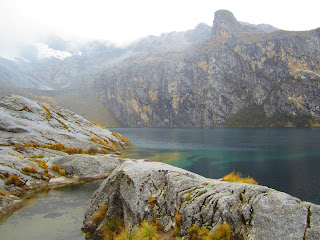
On the second day, we did a short hike about an hour outside of Huaraz to a glacial lake called Laguna Churup, which sits at 15,000ft above sea level. The day was overcast (it is now the rainy season, so clear days are scarce), but we received some great views of valleys and the mountains around us. When we got up to the lake it was raining so I opted to take a few pictures and head back down. On the way back a few of us started getting headaches from the altitude which led to two of our group members getting sick and having to take the next day to rest and recuperate. All in all it was a great hike and we were all happy we did it. Although, after recapping our day with the owner of the hostal, Frank,  we all thought it was a good idea to stick to day hikes since four out five members of our group had never been backpacking, not to mention backpacking above 10,000ft. I was a bit bummed out, but I knew I would enjoy the day hikes and getting to sleep in a bed.
On the third day, as some of our group was taking it easy, Nora (from Italy) and Benedict (from France) and I went repelling in the morning with a guide from our hostel. It wasn't a horrible trip, but I could have spent my money on something better, like eating cuy, but we'll get to that later. It was anti-climactic at best. 
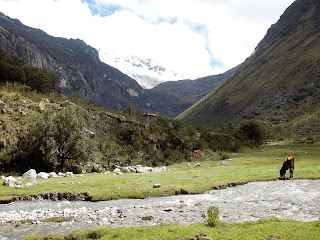
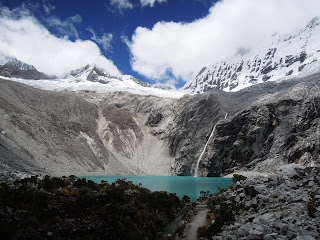
On our fourth and final day, we chose to do a day hike to Laguna 69, which is about 2 1/2 hours from Huaraz in the Huazcuran National Park. This is one of the most amazing places I have ever seen. As we climb up the mountain in our taxi, we are able to catch a glimpse of   Huazcuran (22,000+ft.), the highest peak in the Peruvian Andes Mountains. How awesome did it feel to be among those giant peaks! The further we drove into the Cordillera Blanca Range of the Andes Mountains the more peaks we were able to see; and the more impressive the views became. After paying our 5soles ($1.80us) park entrance fee we were on our way. For the most part the weather stayed clear for our 15kilometer round trip hike to Laguna 69. It received it's name because it was the 69th laguna found in Huazcuran National Park.  At the beginning of our walk there was a small, flat, open valley with green grass, cows, and a glacier fed stream. In any direction we looked we could see tall peaks, glaciers, and waterfalls. Every once in a while even Huazcuran would stick it's head out and say hello. Having not spend that much time in such an atmosphere I found myself walking and smiling an awful lot. After 45mins of walking the valley gave way to steeper trail that switchbacked up to the barren rocks above. Although we were, almost, at 15,000ft above sea level we were still not above the tree line. After just short of three hours of walking we reached Laguna 69. The lake water was a stunning turquoise with waterfalls draining off the glaciers above and walls of gray rock that ascended for thousands of feet. We spent over an hour enjoying the view while eating Andean bread and local cheese we bought off the street in Huaraz. We all agreed it was the best day of our trip to the mountains.
After returning to Huaraz we all took showers, packed our bags, and boarded the bus that would take us back to Trujillo and Huanchaco. Buses are the preferred mode of transportation for most everyone in Peru. They are very inexpensive and reliable, but they can often be uncomfortable and quite long. On our way to Huaraz everything went very smoothly on our bus ride, but on the way back I sat next to a woman who tossed and turned all night and we had a bus driver thought he was in Formula One race. There is a universal downfall to traveling by bus in Peru; Peruvian buses are not made for tall people. The seats are very comfortable and spacious, but if you have long legs you are in for a long ride. There is no way to stretch out, even if the seat reclines fully. I try to choose seats in places that have more leg room, but it hasn't worked yet. I guess it's just something I will have to deal with while I am hear. 
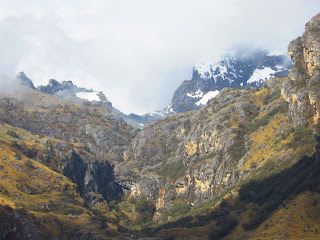


This is the view coming down from Laguna Churup. The lake is just behind the low ridge in the fore ground. 


Laguna Churup 14,600ft. I didn't hangout here too long. It was raining and I had a headache from the elevation.


The beginning of our hike to Laguna 69.

Laguna 69 and all its grandeur 
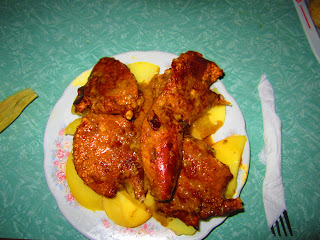
My first cuy (guinea pig) experience. You probably can't tell by this photo, but the whole animal is there. Next to the ceviche in Huanchaco, it's the best food I have had in Peru. It is also the most expensive, 36soles or $13us for a whole cuy with bbq sauce and potatoes.  It was worth every sole.

Lunch crew from left to right: Pancho, a local guide, Nora, Benedict, Chica (don't remember her name), Frank, mountain guide and owner of Andes Camp Hostel and Guiding Service.

Thursday, November 10, 2011

"Miner" Setbacks

So, last night I was supposed to take the overnight bus from Trujillo to Huaraz for 5 days of backpacking in the Cordillera Blanca range of the Andes mountains, but things have changed. Hundreds of miners are on strike/protesting against the mining companies in the area and have blocked mountain roads with debris. The word on the street is that the roads will be cleared today or tomorrow, but no one is really sure. In the meantime, my group and I are waiting in Huanchaco to hear if we will be able to go up there or not. It's a pretty big bummer on my end because I was really looking forward to seeing the area and getting out of Huanchaco for a bit. On the flip side, miners have an extremely dangerous job and, to my knowledge, are treated very poorly in Peru, as with many other places in the world. I have no idea why they are actually protesting, but my guess is that it's for a pretty good reason. I have read it is due to the amount of pollution that the mines are producing, but I'm not 100% sure on that. You can read the article at the bottom to get a better idea, but I don't know the reputation of the publication, so take it for what it is.
I am beginning to think that my trip is pretty insignificant in comparison to the protests. I have plenty of money and can go up there almost any time I want. How can I be upset at these people for interrupting my holiday? While I am on a joy ride, they maybe be fighting for the preservation of their homes and families. I would have to be a pretty big jerk to be upset. Huaraz can wait.


http://www.peruthisweek.com/news-978-Antamina-protests-intensify-in-Acansh-Peru/